Proof Devices, Privacy, & How ZKP Crypto Powers Trust?
We live in a time when almost everything we do leaves data behind web searches, social media posts, health metrics, even what music we listen to. It’s often said that data is the new oil, but oil stored in tanks only works if you trust who built the tank, who has the keys, and whether leaks are possible. In digital systems, that trust is too often missing. A newer kind of infrastructure is emerging that tries to restore it by giving users more control, verifiable guarantees, and real incentives to participate.
The Role of zkP Crypto in Aligning Privacy and Participation
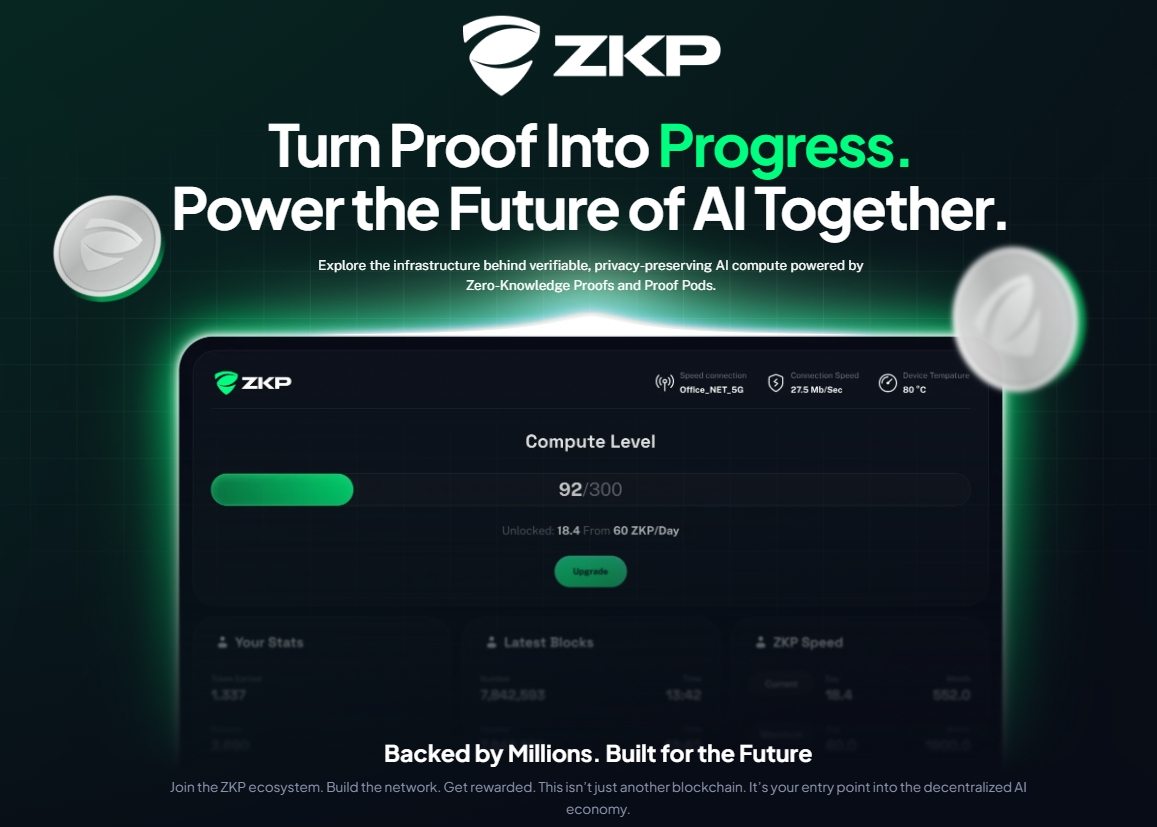
One of the most interesting innovations in this movement is ZKP crypto. It’s more than just a token. It’s the economic backbone of a privacy-first AI compute system where users are rewarded for secure contributions. Whether sharing non-identifying signals, running devices that contribute compute or storage, or helping verify AI models, people earn value via zkP crypto. But the reward isn’t just financial—it’s also about seeing proofs: that AI inference was done correctly, that your contribution counted, that your privacy was respected.
In short, zkP crypto helps glue together several pieces: cryptographic proof (so you don’t need to trust blindly), proof devices (hardware that lets you contribute in ways you control), and a token model that compensates participation while maintaining privacy. It’s a model where trust is built in, not assumed.
What Makes This Infrastructure Work?
For such a system to live up to its promise, several components need to operate in harmony. Here’s a breakdown of how architecture, devices, and economic incentives combine to realize verifiable, privacy-preserving AI.
Proof Devices: Your Personal Gateway to Contribution
-
Proof Pods / Contributor Devices: These are limited-edition hardware units that allow users to securely share certain data signals (like anonymized internet traffic) under finely tuned privacy settings. The goal is contribution without exposure.
-
Granular Control: Users choose exactly what data to share, how often, and under what conditions. Anonymity may be preserved, and no data is forced. You remain in control.
-
Visible Impact: Dashboards show real-time feedback: how your signals or compute were used, how they contributed to model improvements or verifiable AI tasks, and what you’re earning in zkP crypto. The reward loop isn’t hypothetical—it’s transparent and trackable.
Modular Design & Verifiability
-
Decentralized Consensus: Hybrid layers combining proof-of-space (for storage reliability) and proof-of-intelligence (for compute correctness) help ensure both data preservation and that AI tasks are validated properly.
-
Support for multiple runtimes: Developers can use familiar environments (like EVM and WASM) to build smart contracts or AI inference modules. Flexibility matters so innovation isn’t constrained.
-
Native cryptographic proof tools: zk-SNARKs, zk-STARKs, and similar methods are built into the system to allow verification without exposing sensitive inputs. This makes confidential inference and verifiable computation possible.
-
Off-chain storage + cryptographic integrity: Big or sensitive datasets live off the chain for efficiency using networks like IPFS or Filecoin but are anchored to the chain via Merkle proofs or similar integrity checks. You get scale and trust.
Real-World Applications That Benefit Most
Let’s talk about where this kind of architecture isn’t just nice to have it could be transformative.
Healthcare & Research Networks
Medical data is among the most sensitive type of data there is. Hospitals, research centers, and clinics often need to collaborate to build better diagnostic or predictive AI models. But legal, ethical, and privacy constraints make data sharing difficult. Systems that let them share insights without sharing raw patient inputs—and verify model behavior—offer a path forward. Your private health information stays private, but model quality can improve, and trust is verifiable.
Corporate & Proprietary Data Projects
Companies sitting on valuable, confidential data often hesitate to collaborate or share. The risk of exposing internal datasets or competitive secrets is high. With this kind of infrastructure, they can verify external model work, help train models under privacy constraints, and get assurances that nothing private is exposed—while being rewarded (via zkP crypto) for participating in secure ways.
Public Sector, Regulation, Ethical AI
Governments or oversight bodies want fairness, accountability, and safety in deployed AI systems. But they rarely have—or legally can have—access to every private datum feeding into those models. Proof devices, verifiable computation, and privacy-first systems let oversight happen without full exposure. Audits, fairness checks, compliance—all become more feasible, more transparent, and more respectful of privacy.
Enabling Data Economies & Contributor-First Models
Often, the people generating data or compute are the most under-rewarded. They provide value to large models, platforms, or services, but receive little of the benefit. A system that tracks contributions transparently, rewards them with tokens like zkP crypto, and shows you exactly how your participation mattered changes this dynamic. It makes data economies more equitable, more democratic.
Challenges to Overcome
Strong vision, yes but there are practical obstacles, and any roadmap must wrestle with them.
-
Proof Overhead & Efficiency Costs
Generating verifiable proofs for AI tasks (especially complex models) is computationally expensive. Latency and resource usage must be optimized to avoid making systems slow or costly for end users. -
Device Affordability and Usability
Proof devices need to be reliable, secure, yet simple and affordable enough to reach many users—not just early adopters or tech enthusiasts. If cost or complexity is too high, participation remains narrow. -
Cryptographic Safety and Audits
Even small implementation errors in proof systems can cause significant vulnerabilities. Rigorous auditing, transparency, and open tooling are essential. Errors in privacy or correctness undermine trust. -
Balancing Reward Mechanics
Token or reward models need to fairly account for different contribution types (compute, data, storage, validation). Preventing centralization or gaming by large players or early participants is a constant concern. -
Regulatory & Ethical Boundaries
Privacy laws differ by region; what’s acceptable in one jurisdiction may be constrained in another. Ensuring compliance, ethical data use, and obligations for accountability are key. -
Privacy vs Utility Trade-offs
Sometimes privacy constraints limit model performance or speed. Ensuring systems remain useful in real‐world scenarios while preserving privacy and proof guarantees is a delicate design dance.
Signals to Look For & What’s Next
Here are markers that suggest progress, and where things might head in the near future.
-
Launches or shipments of proof devices so users can begin contributing directly.
-
Transparent, fair token distribution or presale mechanisms for zkP crypto.
-
Expansion of development toolkits—SDKs, libraries—that make building proof-based, private AI more accessible.
-
Partnerships with research institutions, medical bodies, or enterprises applying the technology to sensitive data tasks.
-
Community governance structures coming online: voting, policy communication, audit results, contributors shaping how privacy and proof policies function.
-
Improvements in proof technologies: lighter, faster zk proofs; better algorithms; less resource overhead.
Why This Shift Should Matter to You?
Even if you’re not building AI models or managing servers, this technology could influence many things in your digital life.
-
You might gain more agency over your digital footprint—choosing how, when, and what you share rather than having it assumed.
-
Applications you use could become more trustworthy—if they present cryptographic proof of model behavior or data handling.
-
Your contributions whether they’re data signals, feedback, or compute—could start being recognized and rewarded rather than taken for granted.
-
Privacy may no longer be a trade-off you reluctantly accept, but something built into the tools and systems you engage with daily.
Final Thoughts
We’re at a crossroads in technology where the tension between utility and privacy, innovation and trust, has forced a reckoning. The infrastructure built around proof devices, verifiable compute, modular design, and token rewards like zkP crypto represents a pathway toward AI systems that respect people, not exploit them.






Post Comment