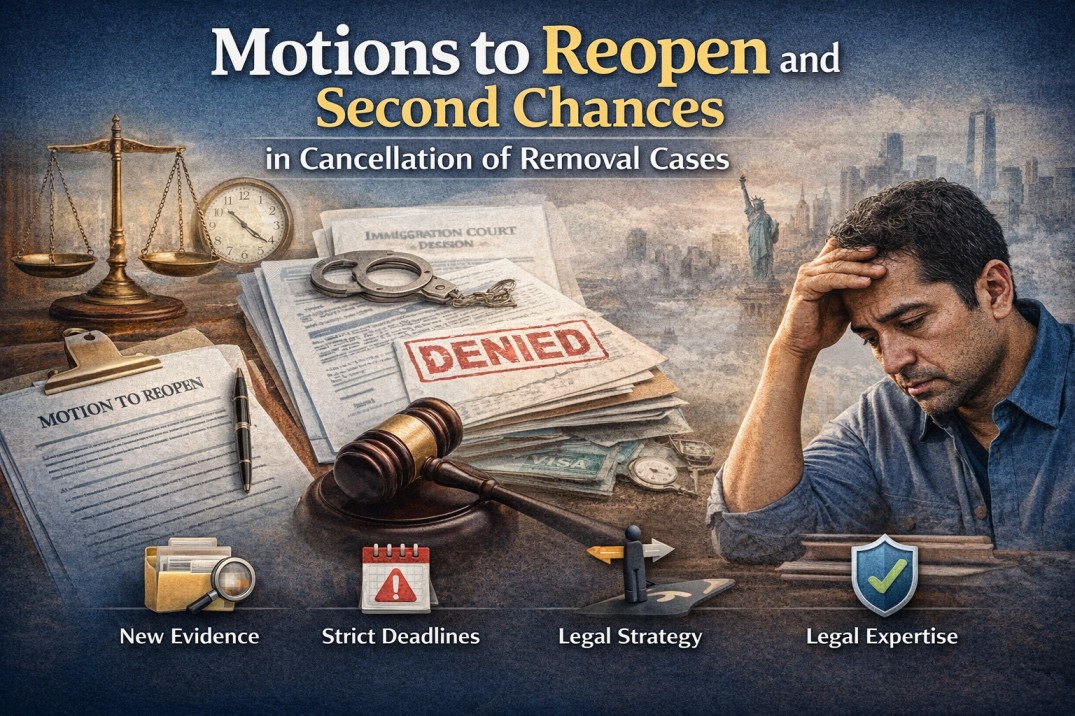
Motions to Reopen and Second Chances in Cancellation of Removal Cases
For many individuals, a denial in immigration court feels like the end of the road. However, removal proceedings do not always conclude with a final, irreversible decision. In certain circumstances, the law allows individuals to seek another opportunity through motions to reopen or reconsider, offering a second chance to pursue cancellation of removal.
This article focuses on post-decision options and why timing and legal strategy are critical after a case appears to be closed.
A Denial Does Not Always Mean Finality
Immigration court decisions can sometimes be revisited when new facts, legal errors, or changed circumstances arise. Motions to reopen are designed to allow courts to review information that was not previously available or considered.
These motions are not automatic and are subject to strict rules and deadlines.
New Evidence Can Change the Case
A motion to reopen may be based on evidence that could not reasonably have been presented earlier. Examples include:
- New medical diagnoses affecting qualifying relatives
- Changes in family circumstances
- Updated country conditions
- Newly available documentation
- Ineffective assistance of prior counsel (in limited situations)
The evidence must be material and directly relevant to cancellation eligibility.
Timing Is Strict and Unforgiving
Most motions to reopen must be filed within a specific timeframe after the court’s decision. Missing these deadlines can permanently eliminate the option to reopen the case, regardless of how strong the underlying facts may be.
Certain exceptions exist, but they require careful legal analysis and supporting documentation.
Motions Are Not Appeals
Unlike appeals, motions to reopen focus on new facts, not disagreement with the judge’s reasoning alone. Applicants must show why the court should reconsider the case based on information that changes the legal analysis.
Confusing these two options often leads to improperly filed motions and lost opportunities.
Strategic Risks Must Be Evaluated Carefully
Filing a motion to reopen carries risks. In some situations, reopening a case may expose the applicant to immediate enforcement if relief is not granted.
This makes strategic evaluation essential before taking action.
Why Legal Experience Matters After a Denial
Post-decision relief is among the most complex areas of immigration law. Working with an experienced Cancellation of Removal Attorney allows individuals to assess whether reopening is viable, prepare legally sufficient motions, and avoid actions that could worsen their situation.
Legal review is especially critical when prior counsel made errors or deadlines are tight.
Preparation Is More Demanding the Second Time
Courts expect motions to reopen to be precise, well-documented, and legally grounded. Weak or repetitive arguments are often denied quickly.
Strong motions clearly explain:
- What changed
- Why it matters legally
- Why the court should reconsider the case
- How relief eligibility is now satisfied
Quality matters more than volume.
Second Chances Are Limited—but Powerful
Motions to reopen are not granted lightly, but when used appropriately, they can change outcomes dramatically. For some individuals, reopening a case leads to renewed eligibility for cancellation of removal and the opportunity to remain lawfully in the United States.
Knowing When to Act Matters
After a removal decision, inaction can close doors permanently. Understanding post-decision options early helps preserve rights and opportunities that may otherwise be lost.
With careful timing, strong evidence, and guidance from a trusted Cancellation of Removal Attorney, individuals may be able to turn a denied case into a renewed opportunity—protecting their future, their family, and the life they have built.








Post Comment