Localized Therapies in Alopecia Areata: A Comprehensive Guide
Introduction
Alopecia areata is an autoimmune condition that causes patchy hair loss on the scalp, beard, eyebrows, or other parts of the body. Unlike generalized treatments, localized therapies focus directly on the affected areas, stimulating hair regrowth while minimizing systemic side effects. This article explores the most effective localized therapies, their mechanisms, benefits, and potential drawbacks.
Definition
Localized therapies in alopecia areata refer to treatment options that are applied directly to the affected areas of the scalp or skin to promote hair regrowth and reduce inflammation. These therapies include topical corticosteroids, intralesional corticosteroid injections, and topical immunotherapy agents like diphenylcyclopropenone (DPCP) or squaric acid dibutylester (SADBE). They aim to suppress the autoimmune response targeting hair follicles while minimizing systemic side effects, making them suitable for patients with limited or patchy disease involvement.
Understanding Alopecia Areata
Alopecia areata occurs when the immune system mistakenly attacks hair follicles, leading to hair loss. The severity can range from small bald patches to complete scalp or body hair loss (alopecia totalis or universalis). Localized therapies are especially useful for patients with limited disease involvement – typically less than 50% of scalp hair loss – where targeted treatment can yield significant improvement.
Why Localized Therapies?
While oral medications or systemic immunosuppressants may be necessary for severe cases, localized therapies:
- Deliver medication directly to affected areas.
- Reduce systemic absorption and side effects.
- Allow individualized treatment for specific patches of hair loss.
- Are often more affordable and safer for long-term use.
Types of Localized Therapies
1. Topical Corticosteroids
Topical corticosteroids are first-line treatment for localized alopecia areata. They reduce inflammation and suppress the immune response around hair follicles.
- Forms Available: Creams, ointments, lotions, gels, and foams.
- Commonly Used Agents: Clobetasol propionate, betamethasone dipropionate.
- Application: Typically applied once or twice daily for several weeks.
- Effectiveness: Best results are seen in patients with small, recent patches of hair loss.
- Side Effects: Skin thinning (atrophy), irritation, and potential systemic absorption if used excessively.
Pro Tip: Occlusion (covering the treated area) can improve absorption but should only be done under medical supervision.
-
Intralesional Corticosteroid Injections
For patients unresponsive to topical therapy, intralesional injections provide a stronger, localized immunosuppressive effect.
- Procedure: Triamcinolone acetonide is injected directly into bald patches using a fine needle.
- Frequency: Usually every 4–6 weeks.
- Benefits: High success rate in promoting regrowth in treated areas.
- Limitations: Less effective for large patches or widespread alopecia. May cause temporary skin depressions or pigment changes at injection sites.
-
Topical Immunotherapy
Topical immunotherapy involves applying chemicals to the scalp to induce mild allergic reactions, stimulating hair regrowth by redirecting the immune system.
- Agents Used: Diphenylcyclopropenone (DPCP), Squaric Acid Dibutylester (SADBE).
- Mechanism: Creates controlled contact dermatitis, altering local immune activity.
- Success Rate: Regrowth occurs in about 40–60% of patients with extensive alopecia.
- Drawbacks: Requires weekly application in a clinic, potential for severe itching, redness, or blistering.
-
Topical Minoxidil
Although primarily known for treating androgenetic alopecia, minoxidil can support regrowth in alopecia areata.
- How It Works: Prolongs the growth phase (anagen) of hair follicles.
- Formulations: 2% and 5% solutions or foams.
- Effectiveness: Works best as an adjunct therapy with corticosteroids or immunotherapy.
- Side Effects: Mild irritation or unwanted hair growth around treated areas.
-
Anthralin (Dithranol)
Anthralin, traditionally used for psoriasis, can be applied to alopecia patches to modulate immune response.
- Mechanism: Causes low-grade irritation, altering immune activity in hair follicles.
- Application: Short-contact therapy—applied for 20–60 minutes daily, then washed off.
- Considerations: May cause skin staining or discoloration of hair and fabrics.
-
Laser and Light-Based Therapies
Low-level laser therapy (LLLT) and excimer laser treatments are emerging options for localized hair loss.
- LLLT: Uses red or near-infrared light to stimulate hair follicles and improve blood flow.
- Excimer Laser: Delivers ultraviolet light to suppress autoimmune activity.
- Advantages: Non-invasive and painless.
- Limitations: Evidence is still evolving; may be less effective as monotherapy.
Choosing the Right Localized Therapy
The ideal treatment plan depends on:
- Extent of Hair Loss: Small patches respond well to topical or intralesional corticosteroids.
- Patient Age: Children may benefit from milder options like topical minoxidil.
- Duration of Condition: Long-standing bald patches may require combination therapy.
- Side Effect Tolerance: Some patients may not tolerate irritation from immunotherapy or anthralin.
Often, dermatologists recommend a combination approach, such as corticosteroids plus minoxidil, to maximize results.
Safety and Monitoring
While localized therapies are generally safe, regular monitoring is essential to:
- Prevent skin thinning or atrophy from corticosteroids.
- Manage allergic reactions from immunotherapy or anthralin.
- Evaluate hair regrowth and adjust treatment accordingly.
Patients should also be aware that:
- Regrowth may take 3–6 months of consistent therapy.
- Relapse is common, even after successful treatment.
- Stress management, nutritional support, and overall scalp care can enhance results.
Challenges in Localized Therapies in Alopecia Areata Market
Limited Long-Term Efficacy:
Many localized treatments provide temporary results, with high relapse rates once therapy is discontinued.
Side Effects and Safety Concerns:
Skin atrophy, irritation, or pigmentation changes from corticosteroids and immunotherapy can limit long-term use.
Variability in Patient Response:
Response to localized therapies differs widely among patients, making treatment outcomes unpredictable.
High Cost of Advanced Therapies:
Emerging options like topical JAK inhibitors and laser devices may be expensive, restricting access for some patients.
Regulatory and Clinical Trial Barriers:
Approval of new localized therapies faces stringent regulatory requirements, slowing down market entry and innovation.
Future Trends of Localized Therapies in Alopecia Areata Market
Rise of Topical JAK Inhibitors:
The development of topical Janus kinase (JAK) inhibitors is expected to revolutionize localized treatment by targeting immune pathways directly at the scalp while reducing systemic side effects.
Integration of Laser and Light-Based Devices:
Low-level laser therapy (LLLT) and excimer lasers are gaining popularity due to their non-invasive nature, with future advancements focusing on portable, home-use devices.
Personalized Medicine & Biomarker-Based Therapy:
Emerging research on genetic and immune biomarkers may allow personalized treatment plans, ensuring higher efficacy and faster regrowth for individual patients.
Combination & Adjunctive Therapies:
Future approaches will likely involve combining localized therapies – such as corticosteroids with minoxidil or immunotherapy – with systemic options for enhanced results.
Growing Market Demand & Innovation:
With increasing awareness, better patient outcomes, and ongoing clinical trials, the market for localized alopecia areata therapies is expected to expand significantly in the next decade.
Growth Rate of Localized Therapies in Alopecia Areata Market
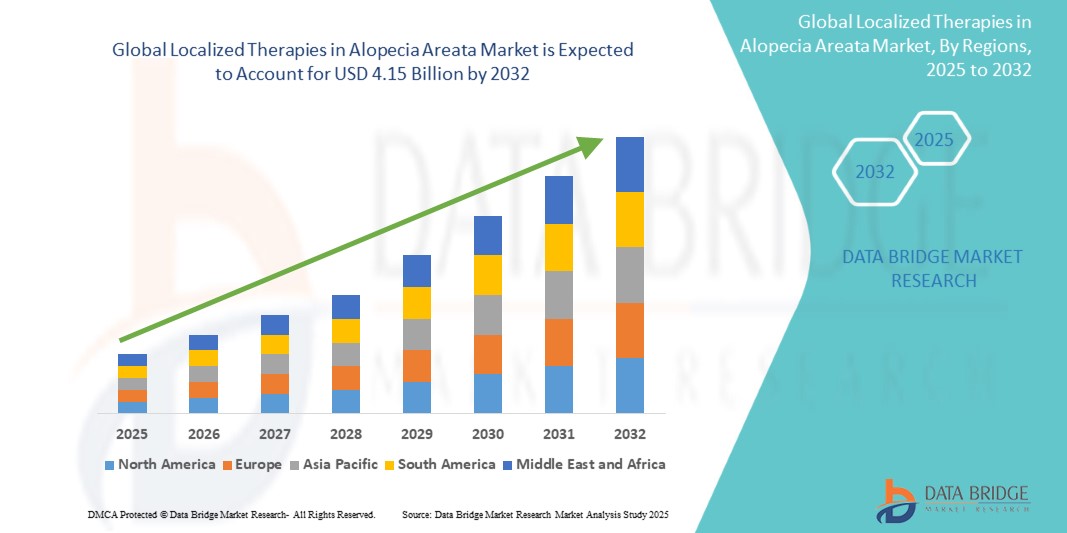
According to Data Bridge Market Research, the localized therapies in alopecia areata market was estimated to be worth USD 2.04 billion in 2024 and is expected to grow at a compound annual growth rate (CAGR) of 9.27% from 2025 to 2032, reaching USD 4.15 billion.
Learn More: https://www.databridgemarketresearch.com/reports/global-localized-therapies-in-alopecia-areata-market
Conclusion
Localized therapies in alopecia areata offer a targeted, effective, and often safer approach for patients with limited hair loss. By delivering treatment directly to affected areas, these methods can promote regrowth, improve confidence, and minimize systemic exposure to medications. Consultation with a dermatologist is crucial for tailoring the right treatment plan and ensuring the best possible outcomes.





Post Comment