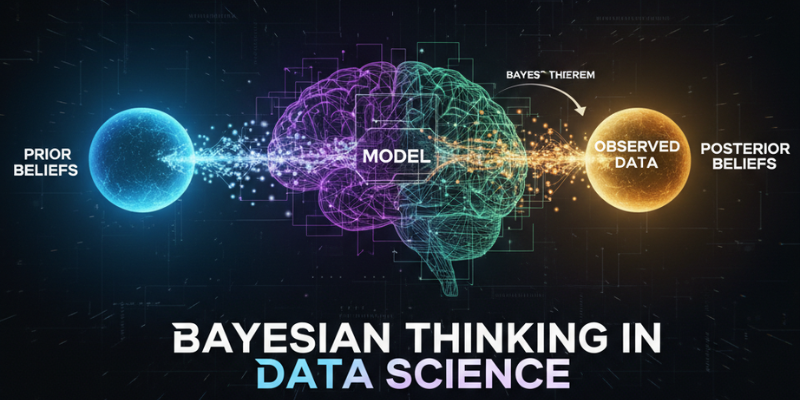
Bayesian Thinking in Data Science
One concept in data science that stands out for its versatility and depth is Bayesian thinking. It provides a structured way of updating beliefs in the presence of new data. Whether you’re building models or interpreting results, understanding this approach can greatly enhance how you handle uncertainty in decision-making. Join Data Science Courses in Bangalore at FITA Academy to master Bayesian thinking and other key data science concepts!
What is Bayesian Thinking?
Bayesian thinking is based on Bayes’ Theorem, a principle in probability theory that explains how to update the probability of a hypothesis when presented with new evidence. Unlike traditional methods that rely on fixed assumptions, Bayesian approaches allow us to refine predictions over time.
At its core, Bayesian thinking revolves around the idea that we start with an initial belief, known as a prior, and then adjust that belief using data, resulting in what we call a posterior. This process is intuitive and mirrors how humans often make decisions in everyday life.
Why It Matters in Data Science
In data science, Bayesian thinking offers a powerful way to deal with uncertainty, especially when data is limited or noisy. Many traditional models make rigid assumptions, but Bayesian methods are flexible and adaptive. They allow analysts to incorporate prior knowledge, which can be extremely useful when past experiences or domain expertise are available.
This concept is particularly valuable when working with probabilistic models, such as in medical diagnoses, fraud detection, or risk analysis. In these areas, outcomes are rarely black or white, and Bayesian reasoning helps manage the shades of gray. Explore how Bayesian thinking can enhance your understanding by enrolling in a Data Science Course in Hyderabad.
Key Components of Bayesian Thinking
To understand how Bayesian thinking works in practice, it helps to know the three main components:
- Prior: This is the initial belief about the likelihood of an event or outcome. It reflects what you know before seeing the current data.
- Likelihood: This represents the probability of observing the data, assuming the hypothesis is true.
- Posterior: This is the updated belief after combining the prior with the observed data.
These elements work together to form a cycle of learning and improvement. As more data becomes available, the posterior from one analysis can become the prior for the next, enabling continuous refinement.
Real-World Applications of Bayesian Thinking
Bayesian thinking is used across a wide range of industries and applications. In healthcare, doctors may start with a prior belief about a patient’s condition based on symptoms and adjust that belief as test results come in. In marketing, analysts can predict customer behavior by updating models as new purchasing patterns emerge.
It is also widely used in machine learning, particularly in Bayesian inference and Bayesian networks, where models estimate the probability of future outcomes while continuously adjusting to new information. These models often perform well even with small datasets because they incorporate prior beliefs instead of relying solely on raw data. Enroll in a Data Science Course in Pune to get practical exposure with these methods.
Benefits of Using Bayesian Approaches
One major advantage of Bayesian thinking is its ability to handle uncertainty more naturally than traditional frequentist methods. It also allows for the integration of expert knowledge, which can improve model performance when data is sparse.
Another benefit is transparency. Bayesian models typically offer probability distributions rather than specific values, allowing decision-makers to grasp the spectrum of potential outcomes instead of concentrating on a solitary prediction. This can lead to more informed and cautious decisions, especially in high-stakes environments.
Challenges to Consider
Despite its strengths, Bayesian methods can be computationally intensive, especially with large or complex datasets. Choosing the right prior can also be tricky, as it introduces subjectivity into the model. However, with advancements in computing and tools like probabilistic programming, these challenges are becoming easier to manage.
Bayesian thinking offers a fresh and flexible way to approach problems in data science. It provides a framework for learning from data in a continuous and adaptive manner. By embracing this mindset, data scientists can build models that are not only more intuitive but also better at dealing with uncertainty. Sign up for a Data Science Course in Gurgaon to learn Bayesian reasoning and more.
As data continues to play a key role in decision-making, understanding and applying Bayesian thinking will remain an essential skill in the data science toolkit.
Also check: Overfitting vs Underfitting With Real-Life Analogies








Post Comment